Trump Seems Trapped by Iran War, Even as He Wields the World’s Biggest Hammer
Trump Thought He Could Hammer Iran Into Submission. Now the War Is Hammering Him.

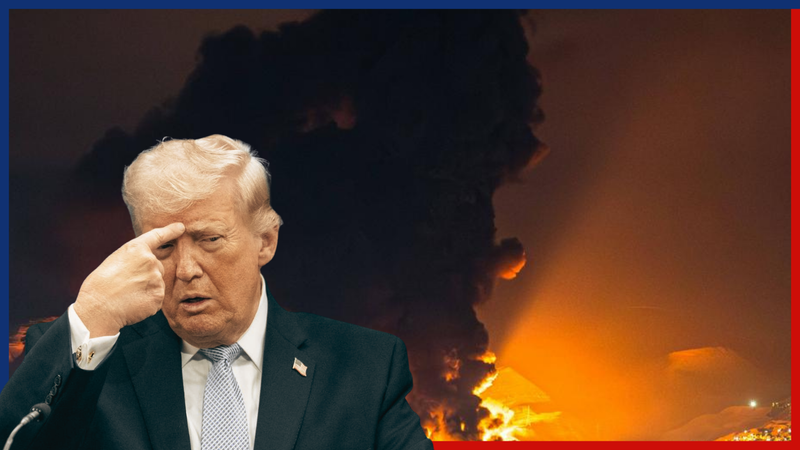
When President Trump ordered the bombing of Iranian nuclear sites and sent commandos to snatch Venezuela's president, he seemed convinced that sheer force could reshape the world to his liking. He told the New York Times he was limited only by "my own morality" as he wielded what he called the world's biggest hammer. But five months into a full-scale war with Iran, the hammer looks heavier than he expected, and his grip on it is slipping.
The goals Trump set on February 28 -- a swift end to Iran's nuclear program and the overthrow of its government -- remain almost entirely unaccomplished. What he once proudly called the "Venezuela model," a quick regime change leading to a government friendly to U.S. interests, has not materialized in Tehran. According to the Times, intelligence agencies now assess that major combat operations are unlikely to work there as they did elsewhere. Trump, once brimming with confidence, is now hesitant to plunge back in.
The costs are piling up. Oil prices are surging, shipping through the Strait of Hormuz has slowed to a trickle, and a second choke point near the Gulf of Aden is now threatened. Trump has publicly acknowledged that there is no appetite for sending in ground troops, even as he floats the idea of seizing Iran's Kharg Island oil terminal or its underground uranium stores. His aides describe him as deeply frustrated, and his behavior has grown erratic even by his own standards.
A President Lashing Out
That frustration is spilling into other areas. Last week, Trump's energy secretary signed a historic nuclear power pact with Saudi Arabia, only for Trump to blow it up less than 24 hours later, declaring the deal dead unless the kingdom recognized Israel and joined the Abraham Accords. Aaron David Miller, a former U.S. diplomat with deep Mideast experience, said Trump "alienated the Saudis, delighted Benjamin Netanyahu and gave Iran strong talking points as to why cutting deals with U.S. is a fool's errand, bound to be betrayed."
The next day, Trump declared the "original Deal" on a $4.5 billion cross-border bridge project with Canada dead and imposed 50 percent tariffs on Canadian goods in what appeared to be a violation of the trade agreement he negotiated during his first term. Canada responded by disinviting Americans from the bridge's opening ceremonies. At home, Trump stunned his own party by refusing to sign a major bipartisan housing bill at the last moment, canceling a planned signing ceremony. His only focus, he said, was a voting law change that did not even have enough Republican support.
The war's unpopularity is hard to ignore. A Washington Post-Ipsos poll found that only 29 percent of Americans approve of Trump's handling of the conflict. Speaker Mike Johnson voiced a growing sentiment among even the president's supporters: "We got to wrap it up."
No Good Options
But wrapping it up is not simple. A month ago, Trump thought he had found his exit, signing a 14-point cease-fire agreement at the Palace of Versailles. He told the Times that Iranian leaders had "had enough" and that the threat of a massive attack forced them to fold. That deal has not held. The Islamic Revolutionary Guard Corps appears to be operating on its own, firing on ships and demonstrating control over the Strait of Hormuz.
Now Trump is left with three unpalatable choices. Military escalation could mean bombing power plants and bridges, but aides have warned that this could cause huge civilian casualties and mass starvation. When asked whether he was hesitant because such strikes could constitute war crimes, Trump said, "I won't respond to that question." There is also a quieter vulnerability: U.S. stockpiles of key missile interceptors have reached critically low levels, a factor officials say influenced his recent decision to hold off. The Center for Strategic and International Studies estimated in April that half of some interceptor inventories may have already been used, and officials now worry that Putin and Xi Jinping are factoring those shortages into their own calculations.
A slower sanctions campaign might work, but it would require a costly, continuous military presence and risk more American lives. Declaring victory and leaving would avoid an economic crisis -- Trump has said he does not want to be compared to Herbert Hoover -- but it would leave Iran with near-bomb grade nuclear fuel and effective control over a critical energy corridor.
The war Trump started to demonstrate his power is instead exposing its limits. Leaving would define his legacy. And it would make clear that there are more constraints on his presidency than he believed back in January, when he declared that his reach was limitless.